Correlative Conjunctions
Today, we will learn about one type of conjunction, i.e., correlative conjunctions, that we use in our daily lives without realising the common mistakes we make, so let’s learn about correlative conjunctions. Do you notice a commonality among the sentences below?
- She is either kind or vicious.
- Neha plays both violin and guitar in the music competition.
In both sentences, a group of conjunctions are used in both sentences.
Correlative Conjunctions are those conjunctions that are utilised in pairs to combine two sentences, nouns, pronouns, adjectives, verbs, adverbs, phrases, objects, subjects, and complements.
List of Correlative Conjunctions
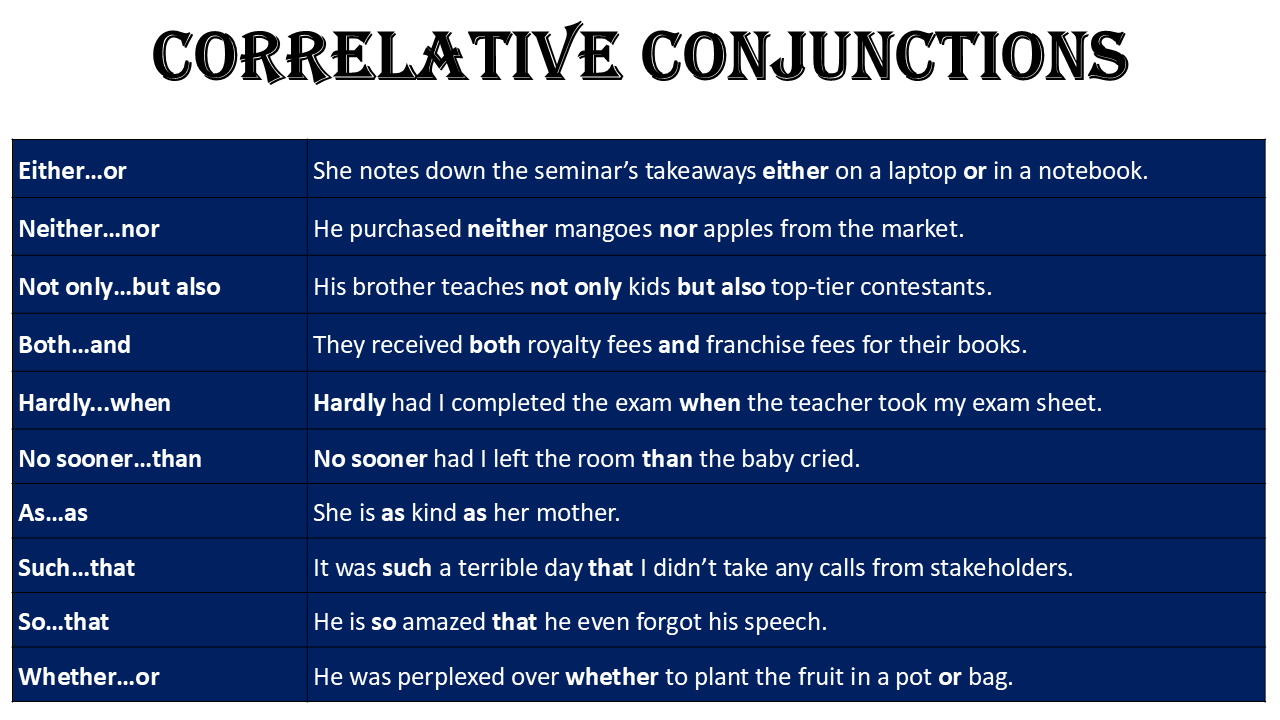
Either…or
Either …………….or conjunctions are used to showcase two opinions; one of them is correct, and the other one is incorrect.
For Example
- Either he or his brother needs to resolve the issue in the project. (CORRECT)
- Either he nor his brother needs to resolve the issue in the project. (INCORRECT)
- She is either kind or clever. (CORRECT)
Neither…nor
The usage of neither…nor is to combine only those two sentences, phrases, pronouns, nouns, adverbs, or adjectives that imply none of them is true.
For Example
- Neither coach nor team is ready to lose this year’s football match.
- She was neither petrified nor cried after watching the horror movie alone in a theatre.
Not only…but also
This pair of conjunctions “Not only…but also” is used to emphasise two features or information about a subject in a sentence dramatically.
For Example
- He has not only won the zonal chess championship but also secured his spot to compete in the nationals.
- Roads had not only a poor drainage system but also numerous potholes.
Both…and
“Both… and” is a pair of conjunctions that are used to showcase two distinct attributes or information in one sentence.
For Example
- We transformed the tyres into planters both skillfully and cautiously.
- They were both amazed and cherished their childhood pictures.
Hardly/Scarcely….when/before
Hardly/scarcely…when/before conjunction is paired in only those sentences where one action or event is completing hardly, then suddenly another event begins.
Note: In this, the first clause is in past perfect tense and goes with the “hardly” conjunction, and the second clause or sentence is in simple past tense and paired up with the “when” conjunction.
Structure: Subject + had + hardly + past participle tense + when + simple past tense
Hardly + had + subject + past participle + when + simple past tense
Hardly + do/does/did + present tense + when + simple present tense
For Instance
- Hardly had she retrieved the data from the memory card when it got corrupted.
- She had hardly reached home when it began to thunder.
No sooner…than
Use “than” with “sooner” as “sooner” is a comparative word. No sooner… than conjunctions are used when one event takes place just after another event.
Structure: Subject + had + no sooner + past participle tense + than + simple past tense
No sooner + had + subject + past participle + than + simple past tense
No sooner + do/does/did + present tense + than + simple present tense
For Example
- No sooner had she sown the seeds in the garden than rain washed away the seeds.
- No sooner had I started to meditate than my brother began to play music at high volume.
- No sooner did she finish today’s deliverables than she started working on urgent ad hoc.
- No sooner did I reach the airport than the flight took off.
As…as
As…as is a pair of conjunctions used to show comparison in an equal way without using “than” in sentences.
Structure: as + adjective/adverb + as
For Instance
- The road’s condition is as bad as last season.
- Her dog is as loyal as everyone says.
- She is not as melodious as her sister.
Whether…or
“Whether…or” conjunction is used to showcase two alternatives, possibilities or opinions.
For Example
- I don’t know whether she will submit the project or not.
- She was confused whether she would arrive by train or flight.
Such…that
Such…that conjunction states the outcome due to a specific scenario.
An adjective is placed just after the conjunction – “such”, and the noun is positioned before the conjunction – “that”. In this pair of conjunctions, the clause that came after the “that” conjunction shows the outcome of the scenario which was explained before the “that” conjunction.
Structure: Such + adjective + noun + that
For Instance
- It was such a deadly storm that it destroyed thousands of residential homes.
- He was such a kind person that he started an NGO to offer employment to poor people.
So…that
“So…that” correlative conjunction is often used to express a cause-and-effect relationship. This conjunction is used with adjectives and adverbs.
For Example
- I was so furious that I forgot to book the concert tickets.
- She is so artistic that she painted the house by herself.
Rules of Correlative Conjunctions
Subject-Verb Agreement
Verbs must be in agreement with the closest noun or pronoun with the second correlative conjunction.
For Example
- Either the teacher or the students were organising the event. (Correct)
- Either the students or the teacher was organising the event. (Correct)
- Neither the supervisor nor the labourers are ready to leave the site. (Correct)
- Neither the labourers nor the supervisor is ready to leave the site. (Correct)
Placement with correlative conjunctions
Always place adjectives, adverbs, nouns, or pronouns after the use of correlative conjunctions.
For Example
- Either she or her sister has created this outfit.
(Here, “she” is a pronoun and is placed after the conjunction ” either, ” and “her sister” acts as a noun and is placed after the conjunction “or”).
Correct Pair of Correlative Conjunctions
Always use the correct pair of conjunctions together in a sentence.
For Example
- She is neither laborious nor wise. (Correct)
- She is neither laborious or wise. (Incorrect)
- Kids are not only curious but also passionate. (Correct)
- Kids are not only curious and also passionate. (Incorrect)
Correct Punctuation
Do not use a comma while using correlative conjunctions to connect clauses, nouns, complements, pronouns, adverbs or adjectives in a sentence.
Exercise on Correlative conjunctions
Choose the suitable conjunctions:
He plays _____ good as Sachin Tendulkar.
- such
- as
- either
No sooner had she started singing _____ everyone gave her a standing ovation.
- than
- that
- nor
He was ______ sad that he forgot to request an autograph from his favourite author.
- such
- as
- so
Her sister was ______ a brave person that she strangled thieves for stealing the money.
- either
- such
- as
They _______ captured the thief but also recovered the stolen money.
- not only
- both
- hardly
Download Free Worksheet PDF – Correlative Conjunctions
Correlative Conjunctions FAQs
What is a correlative conjunction?
A correlative conjunction is a combination of conjunctions that are employed to connect two nouns, pronouns, adverbs, adjectives, verbs, clauses, and complements.
What are the examples of correlation conjunctions?
Examples of correlative conjunctions are:
- Either…or
- Neither…or
- Not only…but also
- Hardly…when/before
- Both…and
- Scarcely…before/when
- No sooner…than
- As…as
- Such…that
- So…that
- Whether…or
What are the common mistakes while using correlative conjunctions?
- Using the wrong pair of correlative conjunctions, such as using “either…nor” instead of “either…or”
- Placing an incorrect verb after the conjunction.