Learn the difference between finite and non-finite verbs in detail with rules. Have you ever wondered why some verbs change their form according to the subject, but others do not? Let’s find out the difference between the cards given below.
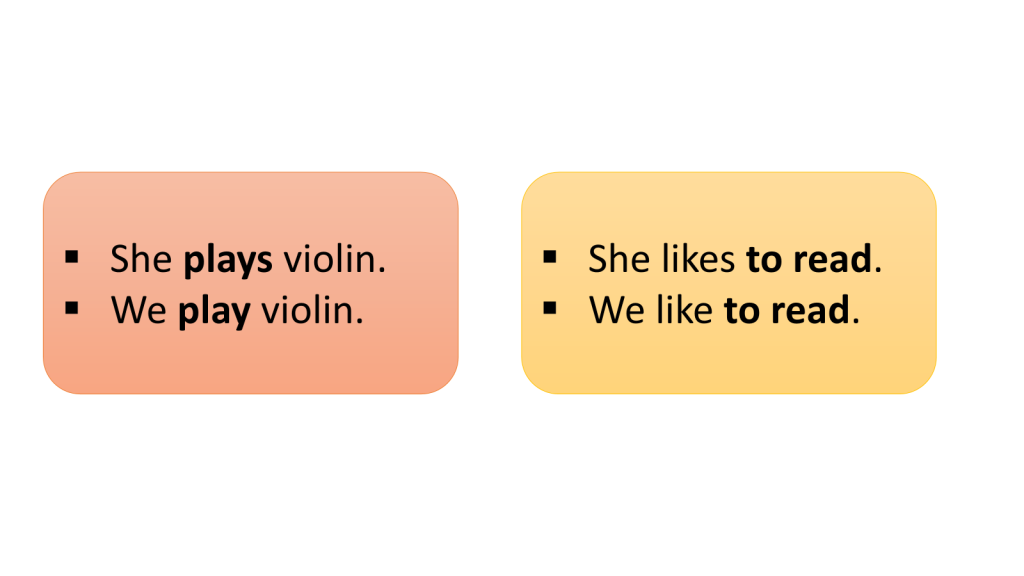
The first card shows “plays and play” verbs that change according to the subject, while the second card shows “to read” verbs that do not change. So, do you know that verbs are divided into two types based on form? The first one is a Finite Verb, and the second is a Non-finite Verb. Let’s learn these 2 classification in detail.
What is a Finite Verb?
A finite verb is a verb that modifies its form according to the subject and tense of the sentence. In other words, Finite verbs are confined to person, number and tense.
Finite Verbs showcase that the action or event happened in the present, past or future.
Examples of Finite Verbs
Finite Verbs transform on the basis of tense
- I drink juice. (Present tense)
- I drank juice. (Past tense)
The Finite Verbs transform their form on the basis of the subject (first person, second person or third person)
- We write the notice on the bulletin board.
(In the given example, the “write” indicates finite verbs, and “We” is used as a subject. Here, the subject “We” is first person, thus the Verb “write” is used)
- He writes the notice on the bulletin board.
(In the above example, “writes” indicates finite verbs, and he is used as a subject. Here, the subject “He” is third person, thus the Verb “writes” is used)
Finite Verbs transform on the basis of number (singular or plural)
- A girl is organising the science expedition.
(In this example, “is organising” is a finite verb because the verb changes its form based on the subject “A girl”, i.e. singular)
- Girls are organising the science expedition.
(In the above example, “are organising” is a finite verb because the verb changes its form based on the subject “Girls”, i.e. plural)
What is a Non-finite Verb?
Non-finite Verbs are verbs that do not change their form according to subject and tense. In addition, Non-finite Verbs never transform their form and are not restricted to subject and tense. In addition, these verbs do not act as the main verb of the sentence and remain constant in every condition.
Examples of Non-finite Verbs
- He wants to run.
(In this example, “to run” is a non-finite verb because “to run” does not have its own subject in the sentence. Therefore, its usage is not restricted to subject and tense.)
- Swimming is a therapy.
(In the above example, “swimming” is a non-finite verb, because firstly, there is no subject in the sentence, and secondly, in this sentence, “swimming” acts as a noun.)
Types of Non-finite Verbs
Non-finite verbs have 3 types:
Infinitive
Infinitives are those verbs that are formed by: “to + Verb 1st form” or “to be + Verb 3rd form”. Examples are: to walk, to read, to find, to go, to drink
Examples of Infinitives:
- To run is good for health.
- I like to sing.
- They have no place to stay.
- To be prepared, you will face a few obstacles before your ballet performance.
Gerund
A gerund is an infinitive verb that is formed by adding “ing” to the main verb. It acts as a noun in the form of a subject, object, or complement of a verb and object of a preposition in the sentence.
For Example :
- Reading is a good habit for kids’ mental health.
- I love singing songs.
- He was rewarded for showing bravery.
Participle
Participle is a verb but acts as an adjective. There are 3 types of participle:
- Present Participle: Verb 1st form + ing
Examples: reading, walking, listening
- Past Participle: Verb ends with d/ed/t/en OR Second/Third form of main verb
Examples: heard, searched, burnt, broken
- Perfect Participle: Having + Verb 3rd form
Examples: Having scolded, having brought, having seen
For Instance
- He invested in a flourishing business.
- Having fallen thrice, she was weeping.
- The vegetables were cooked.
- The crying baby is his brother.
Practice Exercise
Fill in the blanks with the suitable infinitive/gerund/participle form of the verb given in brackets:
- Teachers are eager ________________. (learn)
- ______________ is her passion. (sing)
- The __________ vase is placed on the table. (break)
- She is fond of _______________. (read)
- They love ____________ violin. (play)
- They suggested me _____________ sports shoes for hiking. (bring)
- She earns ____________. (live)
- She throw the ______________ cake. (burn)
- ___________________ his assessments, she watched badminton game. (complete)
- He needs ________________ for ruining the concert. (apologise)
More English Related Articles: